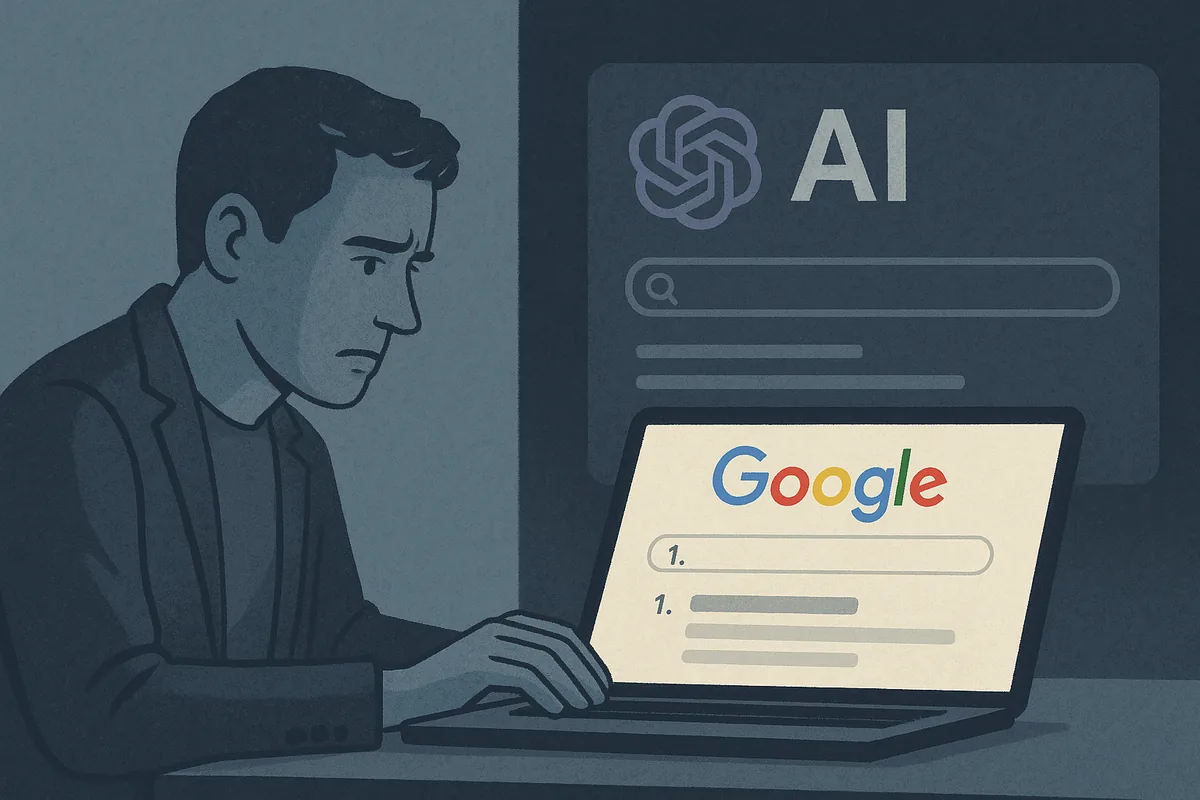
You rank on page one of Google. You did the work. But when someone asks ChatGPT or Perplexity the exact question your site answers, your business is nowhere. That gap is real, it's growing, and it has nothing to do with your domain authority or backlink profile.
Google rankings and AI search visibility are built on different logic entirely. A page Google trusts can be completely invisible to ChatGPT, Perplexity, or Google's own AI Overviews. The reason is simple: AI search engines don't read your backlink profile. They read your sentences. And most SEO-optimised content fails that test completely.
No one has the definitive answer on exactly how each engine selects its citations. But the direction is clear: AI search share is growing fast, early movers are locking in a citation advantage, and the shift in search behaviour is a signal you can't afford to sit out.
How AI search engines actually decide what to surface
AI search engines retrieve answers from content they can parse, cite, and trust as authoritative, not from pages with the highest PageRank.
Most AI tools work through something called RAG (retrieval-augmented generation). The engine goes looking for the best passage it can lift, quotes it, and builds the answer around it. Some of that corpus comes from live web crawls. Some comes from older training data with a fixed cutoff date. Your job is to be the passage it finds.
What matters for retrieval is whether your content contains a clear, extractable answer. The engine needs a passage it can lift, quote, and present without rewriting. If your content buries the answer in the third paragraph behind a wall of context-setting, the engine skips you.
E-E-A-T signals matter here too, but not the way they work in traditional search. AI engines look for named authors, stated credentials, and first-person experience markers. They want to know a real person wrote this, not a content farm.
“AI search traffic is up 527% year over year.”
The 2025 Previsible AI Traffic Report tracked 19 GA4 properties and found LLM traffic rose from roughly 17,000 to 107,000 sessions year on year, reported by Semrush. A small sample, but a steep curve.
I couldn't understand why one client was showing up strongly in every LLM except ChatGPT. Their Google ranking was strong. Then I checked Bing: nearly 80% of their best-performing pages weren't indexed there at all. ChatGPT's search leans heavily on Bing's index, so as far as it was concerned those pages didn't exist.
Why Google rankings don't transfer to AI search results
Google rewards backlinks, technical authority and keyword placement. AI search rewards clear, direct answers written in a form a language model can lift and cite verbatim.
Google's ranking system is fundamentally about trust signals from other pages: who links to you, how authoritative those sites are, how your technical SEO stacks up. A page can rank first with mediocre prose, as long as the link profile is strong enough.
AI search engines don't work that way. They evaluate the content itself. Can the model extract a clean, specific answer from this page? Is it attributed to someone with stated expertise? Is the language plain enough to quote without modification?
| Signal | Google search | AI search engines |
|---|---|---|
| Backlinks | Primary ranking factor | Minimal or no direct weight |
| Keyword density | Still relevant | Less important than semantic clarity |
| Domain authority | Strong influence | Indirect at best |
| Answer structure | Helpful but not required | Required for citation |
| Author attribution | E-E-A-T signal | Directly affects citation likelihood |
| Content freshness | Moderate factor | Depends on crawl frequency |
Being in Google's index does not mean you're in the training corpus or live crawl index of ChatGPT, Perplexity, or any other AI engine. These are separate systems with separate crawlers.
What AI search engines are actually looking for in your content
AI engines favour content that states one clear answer per section, attributes claims to a real person or source, and uses plain language a model can quote without editing.
I think of this as answer extractability. Your content needs to pass a test: can a machine read one section of your page and return it as a standalone answer to a specific question? If the answer is spread across three paragraphs in two different sections, the engine moves on to someone whose content is easier to work with.
The structure that works best is BLUF: bottom line up front. State the answer in your opening sentence. Then support it. Then add context. This is the opposite of how most founders write, which tends to be context first, buildup second, answer buried at the end.
First-person expertise signals matter. A specific claim like “I've audited fifty founder websites this year” is a signal an AI engine can use to assess whether this source has direct experience. Generic third-person content without a named author gives the engine nothing to evaluate.
FAQ and structured Q&A formats are particularly effective for answer engine optimisation. Each question-answer pair is a discrete retrieval unit. Schema markup helps, but the content structure matters more than the markup itself.
The specific content gaps that make founders invisible to AI
Most founder websites lack the three things AI engines use to identify a citable expert: a clear point of view, structured answers to real questions, and demonstrated first-hand experience.
When I first audit a founder's content, it usually looks like it was written without much overall strategy. The structure doesn't help any crawler, AI or traditional, select and rank it well. There's typically a flurry of content from the early days of the business, then big gaps and stale pages as the drag of running a company becomes real.
That pattern is a problem. Stale content signals to crawlers that this source may not be current. Unstructured content signals that answers will be hard to extract. And the absence of a named author with stated expertise means the engine has no reason to cite you over someone who has those signals.
The homepage is often the worst offender. Vague positioning copy like “we help businesses grow” gives an AI engine nothing to retrieve. Compare that to “I help B2B SaaS founders get cited in AI search results”, and you can see which version a language model would actually use.
Most founders are understandably frustrated to see competitors mentioned where they think they should be. What surprises them is where the gap comes from: not being included in editorial comparison content. That is the golden ticket for AI citations.
How to audit your current AI search visibility
Ask ChatGPT, Perplexity and Google's AI Overview the questions your customers type. If your business doesn't appear in the answers, you have a visibility gap worth fixing.
I call this an AI mirror test. You hold your business up to each AI engine and see what reflects back. Here's how to run one:
- Write down the ten questions your ideal customer asks before they hire someone like you or buy what you sell.
- Type each question into ChatGPT, Perplexity and Google, checking for the AI Overview panel at the top.
- Note whether your business, your name, or your content gets mentioned in any of the responses.
- Record which competitors appear instead.
- Save the results as your baseline.
Right now I'm seeing Gemini as the easiest platform to get mentioned on, largely because legacy SEO has been Google-centric and Gemini pulls from that index. If you've been optimising for Google but haven't been fully indexed by Bing, ChatGPT may be overlooking your business entirely.
That baseline matters. Without it you're guessing. With it, you know exactly which queries to target and which platforms need work first.
What fixes AI search visibility for a founder-led business
Publishing direct-answer articles, FAQ pages and experience-led content that names your expertise closes the gap between Google presence and AI search presence.
The fix isn't complicated, but it does require a different kind of content than most founders produce. You need content structured for extraction, not just for reading.
That means FAQ pages where each answer is self-contained. Articles where every section opens with a direct statement. Posts written in first person with specific examples from your actual work, not generic advice that could have come from anyone. This is what Build is designed to produce.
Your founder voice is a genuine differentiator. AI engines are trying to identify authoritative sources. A named founder with stated expertise writing from experience is exactly what they look for. Generic, unsigned content from a brand blog carries less weight.
Technical SEO still matters as the foundation. If your pages aren't crawled cleanly, nothing else helps. Getting the technical work right makes your site an economical target for crawl budget allocation, dotting the i's so the crawler bothers coming back.
Named authors with verifiable expertise have a moderate positive effect (+26%) on AI citation rate.
MarGen, drawing on research from Georgia Tech and GEO.mit.edu.
Why this gap keeps widening the longer you ignore it
AI engines reinforce the sources they already cite. The longer your content stays unstructured, the more your competitors' answers get embedded as the default response.
This is a compounding problem. When an engine cites a source for a query and users engage with that answer, it learns to trust that source for similar queries. The cited source gets more exposure. More exposure means more editorial mentions, which means more citation weight.
I've seen this play out directly. Competitors who become the default answer in a space usually get there through good exposure in editorial and comparison content from major publications. Those mentions aren't easy to get, and publications are selective. But they hold significant weight in AI search.
Content on non-network domains had a citation half-life of roughly 4.5 weeks. On Stacker network domains it was nearly 10 weeks: a 2.1× durability advantage.
Stacker / Scrunch source-decay research. Worth noting Stacker is measuring its own distribution network, so read the size of the effect with that in mind, but the underlying finding, that citations decay, holds.
For solopreneurs and small-team founders, the cost of inaction is real. Every month your content stays unstructured, a competitor with cleaner answers is training these engines to prefer them.
Google presence and AI presence are two different jobs
SEO built your Google rank by earning trust from other pages. AI visibility requires earning trust from language models, which means your content has to do the talking on its own.
Founders now have a two-layer search strategy to manage. The first layer is traditional: build domain authority, earn backlinks, optimise for keywords. That work isn't wasted. Google still sends traffic, and Gemini pulls from that index.
The second layer is entirely about the content itself. No link profile saves you here. Your sentences, your structure, your stated expertise: that's what gets retrieved. Google search is a reputation contest. AI search is more like a job interview where you submit one written answer and the hiring manager has ten seconds to decide if you're worth quoting.
And AI search is a direct-answer medium. There's no list of ten blue links where you can still catch a click at position seven. You're either the cited source or you don't exist in that answer. Binary.
Frequently asked questions about AI search visibility
Straight answers to the questions founders ask most when they first discover the gap between their Google ranking and their AI search presence.
Does publishing more blog posts improve my AI search visibility?
Volume alone doesn't help. AI engines prioritise content with clear structure, named expertise, and direct answers. One well-structured FAQ page outperforms ten vague blog posts for AI retrieval. Quality and extractability beat quantity every time.
How long does it take to appear in AI search results?
There is no fixed timeline because it depends on when your pages get crawled. Perplexity crawls live content and can surface new pages within days. ChatGPT's training data has a cutoff, so it may take months to appear in responses there. Requesting indexing and having your technical SEO correct speeds up the process.
Will fixing my technical SEO help with AI search?
Yes, as a foundation layer. AI engines need to crawl and parse your pages cleanly. Technical issues that block indexing also block AI retrieval. Technical SEO is the necessary first step before content optimisation delivers results.
Do AI search engines use Google's index to find answers?
Google's AI Overviews pull from Google's own index. Perplexity and ChatGPT use independent crawlers and training data. Being indexed by Google does not guarantee presence across other AI search engines. If you're not indexed by Bing, ChatGPT's search features are unlikely to find you.
Is AI search visibility only relevant for big brands?
No. AI engines cite the clearest answer, not the biggest brand. A founder with specific, structured expertise on a narrow topic can outperform a large competitor whose content is too broad to extract.
In summary
AI search engines select answers based on content structure and stated expertise, not backlink profiles. Google rankings do not transfer automatically to AI search visibility. Founders who restructure their content for answer extraction gain a compounding citation advantage over competitors who wait.
Find out where your business stands in AI search right now
AEO Growth Kit audits your technical SEO, runs AI mirror tests to find your content gaps, and produces the articles and FAQs that get founders cited in AI search results.
If you ranked on page one of Google and assumed you were covered, the gap is worth measuring. The audit takes the guesswork out: you'll see exactly where you appear, where you don't, and what to fix first.
Run your free 5-page audit See how AEO Growth Kit works
Sources
- Semrush, AI SEO statistics, reporting the 2025 Previsible AI Traffic Report.
- MarGen, What content does AI prefer to cite?, drawing on Georgia Tech and GEO.mit.edu research.
- Stacker, Source decay research: the Stacker network effect on AI citation persistence.